
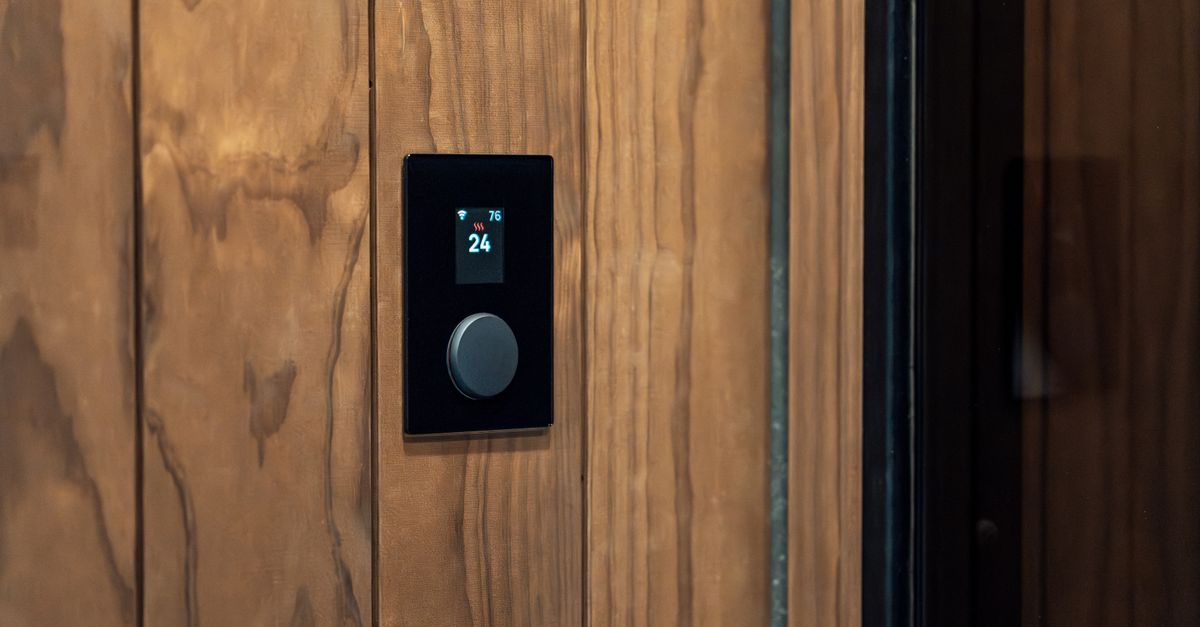
If fast heat-up and Wi-Fi control matter most, choose an electric sauna heater sized for the entire room, including its glass surfaces, and pair it with a control system approved for that exact heater. For an indoor sauna, our first recommendation at Patio Life is to start with the FINSAUNA Therma collection. These traditional indoor saunas include Wi-Fi control, so you can evaluate the room and its controls together rather than choosing a heater and hoping a separate app will work with it.
The important distinction is that Wi-Fi makes preheating convenient; it does not make the heating elements warm the room instantly. A fast, practical setup depends on the heater’s match to the sauna volume, glass area, insulation, ventilation, stone arrangement, and starting temperature. If you want to start a session from your phone, confirm the specific control functions and remote-operation safety requirements before you order.
For a custom sauna or a different cabin design, the same principle applies: select the room and heater first, then confirm an approved Wi-Fi control package for the exact configuration. Patio Life also offers home sauna options from FINSAUNA, Auroom, and Saunum, along with HUUM heater accessories. The right choice is the complete, compatible system, not the heater with the largest power rating or the most appealing app.
What do fast heat-up and Wi-Fi control actually mean?
Heat-up time is the time between switching on a cold sauna and reaching conditions you find comfortable for a session. It is not a fixed specification for a heater on its own. A heater that performs well in a compact, insulated room may take longer in a room with a broad glass front or in an outdoor sauna on a cold day. The air temperature shown on a controller is useful, but the benches, walls, and stones also influence how the room feels when you enter.
Wi-Fi control means a compatible control system can connect the sauna to an app or network-based controls. Depending on the system, functions may include remote start, scheduling, and temperature adjustment. Those functions should be checked for the particular heater and controller combination. A heater with electronic controls is not automatically app-enabled, and a Wi-Fi accessory is not automatically suitable for every heater.
These are separate decisions that need to work together. The heater determines how effectively the sauna warms. The control system determines how you operate it. If both are priorities, shop for them as one system.
Our recommendation for an indoor sauna
The FINSAUNA Therma collection is a useful starting point when you want a traditional indoor sauna with Wi-Fi control as part of the sauna configuration. The collection includes models for two to six people, with two-level seating, Nordic spruce walls, Thermo-Aspen accents, glass fronts, and LED lighting. Those details matter to this decision: the glass contributes to heating demand, while the available sizes let you choose a room that fits the people who will actually use it.
We would begin by choosing the Therma size and seating layout, then discuss the heating configuration and how the controls operate on that particular model. Do not choose a larger room simply because you may host extra guests occasionally. The room you heat for every solo session should still make sense for everyday use. Conversely, do not choose the smallest room if the bench space will make regular use uncomfortable.
For a different indoor layout, the FINSAUNA Isla collection offers traditional cabins for two to four people or a lounge configuration, with two-tier benches and glass fronts. Its layout may be a better fit for how you sit or recline, but if app control is essential, settle the exact heater and controller arrangement before treating it as an alternative to a Wi-Fi-equipped Therma. For outdoor plans, start with an outdoor-rated cabin and heater rather than assuming an indoor setup can be placed outside.
How to choose the heater and control system together
1. Measure the full sauna room, not just its floor
Heater selection begins with room volume: length multiplied by width multiplied by height. Floor area alone misses the effect of ceiling height. Write down the interior dimensions, then identify glass doors, windows, and other surfaces that do not retain heat like an insulated sauna wall. The heater manufacturer’s sizing guidance should determine how those surfaces affect the recommended heater range.
Consider a hypothetical room that is 7 feet long, 6 feet wide, and 7 feet high. Its basic volume is 294 cubic feet. That figure is only the starting point. If the design includes a glass front, a heater sized solely for 294 cubic feet may not be the best match. The correct adjustment depends on the heater manufacturer’s instructions, not a universal upgrade rule.
This is where a showroom conversation is more useful than selecting a heater by the number of seats in the product name. Bring a sketch with interior dimensions and glass locations. If the room is outdoors, note that too. The goal is to compare the room’s effective heating demand with the specific heater’s rated range.
2. Prioritize correct sizing over the largest kilowatt number
A heater that is too small for the room can feel slow, particularly if the design has extensive glass or the sauna starts cold. But choosing the most powerful heater that will fit is not a sound shortcut. Its electrical requirements, clearances, controls, and approved room-size range still have to suit the installation.
Think of heater power as one part of a matched design. A suitable heater needs to cover the room it will actually heat, work with the intended controller, and meet the site’s electrical requirements. A larger unit cannot compensate for a poor room design by itself. Likewise, a well-insulated cabin cannot make an incompatible controller safe to use.
If you have seen generic kilowatt-per-volume rules, use them only to understand why a bigger room generally needs more heating capacity. Select the final model using its manufacturer’s sizing chart and installation instructions, including any adjustment for glass and uninsulated surfaces.
3. Check the controls before selecting the heater variant
Some heater families offer different control arrangements, such as built-in controls or a version intended for a separate control unit. Those versions are not interchangeable just because the heater body looks similar. Ask which specific heater variant is compatible with the Wi-Fi system you want.
Make a short list of the functions you will actually use:
- Remote preheating: Can you start heating from your phone under the approved installation conditions?
- Scheduling: Can you set the sauna to begin heating ahead of a regular session?
- Temperature adjustment: Can you change the target setting through the intended control interface?
- Local operation: Is there a straightforward way to operate the sauna at the cabin?
- Safety functions: What sensors, door monitoring, timers, and other protections does this configuration require?
A feature list for an app is not enough. The answer needs to apply to the heater, control unit, and installation you are buying. If remote start is the reason you want Wi-Fi, confirm that specific function rather than assuming it follows from the presence of an app.
4. Check the electrical plan before placing the order
The heater’s rated power affects its electrical requirements. Have a qualified electrician confirm the supply, circuit, wiring, protection, and control connections required by the chosen model. The heater and controller instructions also determine where components and sensors must go. Electrical planning is especially important if you are choosing between heater sizes or placing the sauna away from the house.
For a fuller planning checklist, read our guide to electrical, ventilation, and flooring requirements before ordering a home sauna. It is easier to settle those questions while comparing cabins than after a sauna has arrived.
5. Plan the network connection and day-to-day routine
A Wi-Fi controller needs a reliable connection where its network components will be installed. Check signal coverage at the proposed sauna location, particularly if it is at the far end of the yard. Then think through the routine: will you start the sauna when leaving work, schedule it before a recurring evening session, or simply use the app from another room in the house?
That routine determines which features deserve priority. A person who wants predictable sessions may value scheduling most. Someone with an irregular schedule may care more about remote start. Either way, an accessible local control remains useful when a phone is not nearby or the network is unavailable.
What makes a sauna feel ready sooner?
The quickest way to improve the experience is not always to seek a faster heater. It is to remove the factors that make the room harder to warm and to start preheating at the right time.
Room construction and glass
Insulation and a well-designed enclosure help the heater retain the heat it produces. Glass fronts create an open, inviting look, but they also change the room’s heating demand. That is relevant to Therma and Isla designs, both of which feature glass fronts. When comparing sizes or layouts, ask how the chosen heater accounts for the actual amount of glass.
A door that does not close properly can also affect the experience. Address fit and construction issues instead of compensating by choosing an oversized heater. If you are designing a sauna from scratch, consider the heating implications of every large glazed surface before finalizing the heater.
Indoor versus outdoor starting conditions
An indoor sauna generally begins closer to a conditioned home’s temperature than an outdoor sauna does during an Idaho winter. That difference can change how early you need to start heating. Remote preheating is particularly convenient outdoors, but it should be treated as a way to manage the wait, not a guarantee that cold-weather heat-up will match an indoor session.
If the sauna will live outside, cabin durability, placement, and access matter alongside the heater. Our guide to choosing an outdoor sauna for Idaho weather and family use covers those broader decisions. Choose an outdoor configuration appropriate for its location before narrowing down the control system.
Ventilation and stone loading
Airflow is part of the sauna design. Blocking vents to hold in heat is not a sensible heat-up strategy; follow the sauna and heater instructions for ventilation and sensor placement. The heater stones also need to be installed as directed. Packing them incorrectly can interfere with the airflow the heater is designed to use.
Different heaters use different stone arrangements and amounts. A larger stone load may appeal to someone who values the feel of the heat and the steam produced when water is used appropriately, but it should not be assumed to deliver the shortest warm-up. Compare the exact heater design with the session experience you want.
Your definition of ready
Two people may enter the same sauna at different points in the warm-up and have different opinions about whether it is ready. A displayed temperature can rise before the entire room feels evenly warm. If you prefer a fully warmed bench and stones, allow for that in your routine rather than judging performance by the first moment the controller reaches its set point.
Once your sauna is installed, note how long a normal cold start takes in conditions you commonly encounter. Use that observation to set a preheating schedule. Our article on how long a traditional home sauna takes to heat up explores the factors behind that variation.
Which heater and control approach fits your priorities?
There is no single heater model that is automatically the fastest in every sauna. These are the approaches we would compare, starting with the most direct fit for an indoor buyer seeking both priorities.
- Patio Life’s indoor starting point, FINSAUNA Therma: Choose this route if you want a traditional indoor cabin with Wi-Fi control included in the collection’s features. Select the right room size, then review the model’s heating and control configuration together.
- A different cabin with a compatible electric heater and Wi-Fi controller: Choose this route if layout or outdoor placement leads you to another sauna. Confirm the heater variant, approved control package, electrical requirements, and remote-operation conditions as one purchase decision.
- A heater selected primarily for its stone experience: If the character of the heat matters more than the shortest possible wait, compare stone-heavy designs alongside their approved controls. Ask about warm-up expectations for the actual room instead of assuming that the presence of Wi-Fi resolves the trade-off.
- Wood-burning heat: Choose this for the hands-on fire-tending experience, not as the direct answer to app-based starting. Heating a wood-fired sauna involves lighting and managing a fire, so it does not serve the same remote-control goal as a compatible electric system.
If both speed and phone control remain nonnegotiable, we would return to a correctly sized electric setup with approved Wi-Fi control. The cabin and its heating demand determine which exact configuration belongs on the shortlist.
Best practices for reliable Wi-Fi sauna use
- Confirm remote-start safeguards. Ask which safety equipment and checks the manufacturer requires for your installation. Follow those requirements every time you use remote operation.
- Keep the heater area clear. Before starting the sauna remotely, make sure nothing has been placed on or near the heater that should not be there. A connected app cannot inspect the room for you.
- Use a realistic preheat schedule. Base it on your sauna’s observed cold-start behavior, with extra allowance when outdoor temperatures are lower.
- Retain local controls. Know how to operate and turn off the sauna at its installed controls without relying on your phone.
- Follow the specified ventilation arrangement. Do not close vents or move sensors in an attempt to shorten warm-up.
- Keep the room in good condition. Wipe seating and surfaces as directed, check for wear, and address door-fit or ventilation issues that affect everyday performance. Our sauna wood-care guide covers routine attention to benches and walls.
These habits matter more than finding an app with the longest feature list. A useful Wi-Fi system makes a sound sauna setup easier to live with; it cannot replace correct sizing, installation, and safe operation.
Questions to bring when comparing systems
When you visit a showroom or review a quote, ask for answers tied to the specific model rather than a broad brand description:
- What is the sauna’s interior volume, and how is its glass accounted for in heater sizing?
- Which exact heater model and control unit are included?
- Does this configuration allow the app functions I care about, especially remote start and scheduling?
- What safety equipment or checks are required for remote operation?
- Where will the physical control, sensors, and network components be installed?
- What electrical work must be completed before the sauna can be used?
- What warm-up behavior should I expect for this room, particularly if it will be outdoors?
Bring the proposed location, room dimensions if you already have them, and a description of when you expect to use the sauna. Those details make a recommendation more useful than asking only, “Which heater is fastest?” For more context on cabin layouts, our FINSAUNA, Auroom, and Saunum comparison can help narrow the overall sauna choice.
Frequently asked questions
Should I buy a more powerful heater to reduce warm-up time?
Only if the manufacturer’s sizing guidance calls for it. The heater must suit the room’s effective volume, including glass and other heat-demanding surfaces, and the electrical installation must suit the heater. Selecting a larger rating without checking those requirements is not a reliable shortcut.
Is a Wi-Fi sauna heater different from a regular electric heater?
Wi-Fi capability comes from a compatible control configuration, not simply from the heater being electric. Some systems combine a heater with a separate controller, while others include connected controls as part of a sauna package. Confirm the exact heater and control pairing before purchase.
Can I add Wi-Fi control to a sauna heater later?
That depends on the exact heater and available approved control options. Do not assume a general-purpose switch or an unrelated Wi-Fi module can be added. If phone control is important, choose the compatible arrangement at the outset.
Does scheduling make a sauna heat up faster?
No. Scheduling starts the warm-up earlier so the sauna can be ready when you want to use it. Heater sizing, room design, and starting conditions still determine the heating process.
Will a glass-front sauna take longer to heat?
Glass affects heating demand and needs to be accounted for when choosing the heater. The amount of glass and the manufacturer’s sizing guidance matter more than a blanket rule about how much extra time it will take.
Is an outdoor sauna a good fit for Wi-Fi preheating?
It can be, provided the cabin, heater, and controls are appropriate for the installation and the network connection reaches the control equipment. Outdoor starting temperatures vary, so the preheat schedule may need to change with the weather.
Which is better if I care about both convenience and traditional sauna heat?
A correctly sized traditional electric sauna with approved Wi-Fi controls is the clearest match. You can retain a traditional heated-stone sauna experience while using the controls to plan sessions around your day.
What should I confirm before starting a sauna remotely?
Follow the manufacturer’s remote-operation instructions, including any required safety devices and room checks. In particular, make sure the heater area is clear and the sauna is in the condition required for remote use. Phone access is a convenience, not a substitute for those checks.
Choose the complete setup, not just the heater
For fast, convenient sessions, the strongest choice is a well-matched electric heater in a properly designed sauna, paired with a control system approved for that exact installation. If you want an indoor starting point with Wi-Fi already part of the collection’s features, begin with FINSAUNA Therma. If your preferred cabin or outdoor location calls for another route, compare the room, heater, controls, and electrical plan together before committing.
At Patio Life, we help homeowners in the Boise, Meridian, and Eagle area compare sauna layouts and heating choices in person. Bring us your space and your ideal session routine, and we can help you narrow the choices to a sauna you will enjoy using regularly.
